

Why Real-Time Cash Flow Is Reshaping SME Credit
Imagine two businesses.
The first owns a warehouse, expensive machinery, and valuable property. On paper, it looks creditworthy.
The second owns very little. Yet it invoices customers every month, pays employees on time, and has a steady stream of recurring revenue.
Traditional lending often chooses the first.
Modern finance is increasingly choosing the second.
Because the strongest predictor of a business’s ability to repay isn’t what it owns, it’s how consistently cash moves through the business.
That’s why cash flow is becoming the new credit score.
SMEs Keep Economies Running, But Not Always Their Cash Flow
Small and medium-sized enterprises are often described as the backbone of the global economy, and for good reason. Across emerging markets, they drive innovation, create jobs, and fuel local economic growth. From family-owned manufacturers and neighborhood retailers to technology startups and logistics providers, SMEs are the businesses that keep economies moving.
SMEs represent around 90% of businesses and more than half of employment worldwide. Yet many growing businesses remain underserved by traditional finance, not because they lack demand or commercial potential, but because they lack collateral, long credit histories or financial statements that reflect their current performance.
The issue is often not profitability. It is timing.
This disconnect reveals a fundamental flaw in how businesses are traditionally assessed. The companies creating jobs, serving communities, and generating consistent revenue are often the very ones that struggle to access the capital they need to grow. Not because they lack demand or profitability, but because they don’t fit conventional lending models.
As economies become increasingly digital and business models evolve, the question is no longer whether SMEs deserve greater access to finance. The question is whether the financial system is measuring the right indicators in the first place.
The Problem Isn’t Profit. It’s Timing.
One of the biggest misconceptions in SME finance is that profitable businesses always have healthy cash positions.
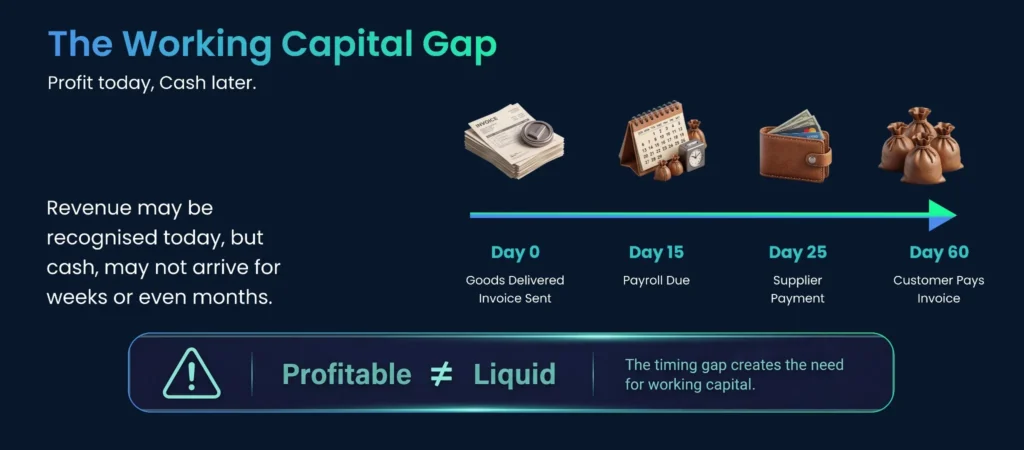
In reality, revenue recognition and cash collection rarely happen at the same time. A company may have delivered products, issued invoices, and secured future income while still lacking the liquidity to meet payroll, pay suppliers, or purchase inventory.
This working capital gap is one of the most common challenges facing growing businesses. Revenue may be recognised today, but cash may not arrive for weeks or even months. Meanwhile, operating expenses, salaries, supplier payments, rent, utilities, and inventory cannot wait. The result is a working capital gap, in which otherwise healthy businesses find themselves constrained not by profitability but by liquidity.
This challenge is especially pronounced in emerging markets, where access to short-term financing remains limited. According to the International Finance Corporation (IFC), nearly 40% of formal MSMEs in developing countries are credit-constrained, contributing to an estimated US$5.2 trillion annual financing gap. When informal enterprises are included, the financing gap widens by another US$2.9 trillion, underscoring how widespread the challenge has become.
For many businesses, the consequences extend beyond delayed growth. A temporary cash shortfall can mean postponing expansion plans, turning down new contracts, delaying supplier payments, or relying on expensive short-term borrowing simply to keep operations running. The business itself may be fundamentally healthy; it just doesn’t have access to the cash it has already earned when it needs it most.
Liquidity challenges are forcing lenders and fintechs to rethink how businesses are evaluated.
Why Traditional Credit Scores Miss the Bigger Picture
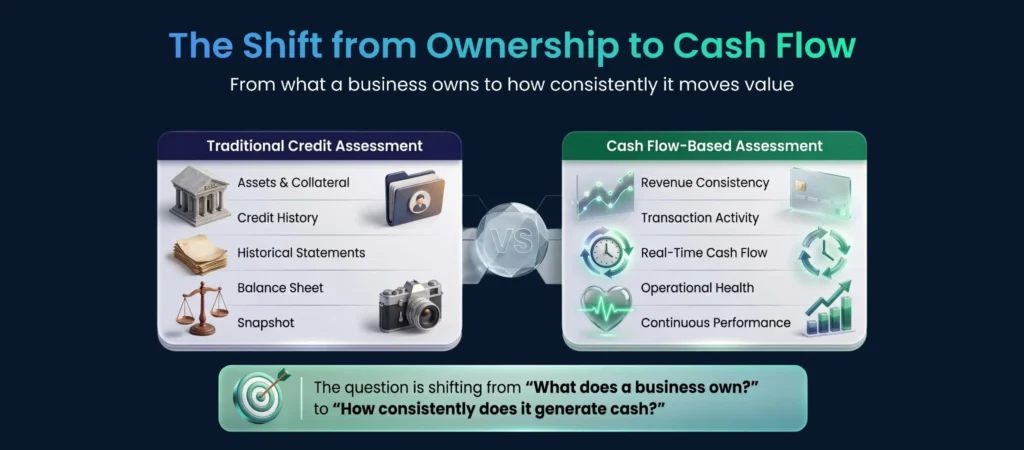
For decades, access to business finance has been built around a simple question: What does this company own?
Traditional underwriting relies heavily on historical financial statements, collateral, credit history, and fixed assets to determine whether a business is creditworthy. While these indicators have long served as proxies for risk, they were designed for an economy where value was tied primarily to physical assets.
Today’s businesses often look very different.
A software company may have recurring revenue but little tangible collateral. An e-commerce business may process thousands of transactions every month without owning a storefront. A logistics company may have predictable contracts and healthy cash inflows but limited fixed assets. Under traditional lending models, many of these businesses appear riskier than they actually are.
The challenge isn’t that conventional credit scoring is wrong. It’s that it’s increasingly incomplete.
A balance sheet provides a snapshot of where a business has been. It doesn’t always capture how that business is performing today or where it’s headed tomorrow.
In an increasingly digital economy, business health is becoming less about static assets and more about the continuous movement of money through the business.
Even when lenders look beyond collateral, they often rely on financial ratios such as the Debt Service Coverage Ratio (DSCR) to assess repayment capacity. Many institutions use DSCR thresholds of approximately 1.0–1.25 as a benchmark for lending decisions. While this offers a stronger view of a company’s ability to service debt than collateral alone, it is still based on historical financial performance rather than real-time business activity.
Traditional underwriting relies on useful measures: financial statements, repayment history, collateral and coverage ratios. The limitation is not that these tools are wrong. It is that they are often periodic and backward-looking.
A balance sheet may show what a business owned several months ago, but it does not always show how reliably that business is collecting revenue, meeting payroll or paying suppliers today. This is particularly limiting for asset-light businesses such as software companies, e-commerce platforms and service providers whose strength may not appear clearly on a traditional balance sheet.
Transaction and operating data can add that missing layer. Regular inflows, stable collections, manageable outflows and predictable operating cycles provide a more current view of business resilience.
Cash-flow data should not replace traditional credit assessment. It should make it more complete.
Cash Flow Is Becoming the Better Indicator
Every payment a business receives tells a story.
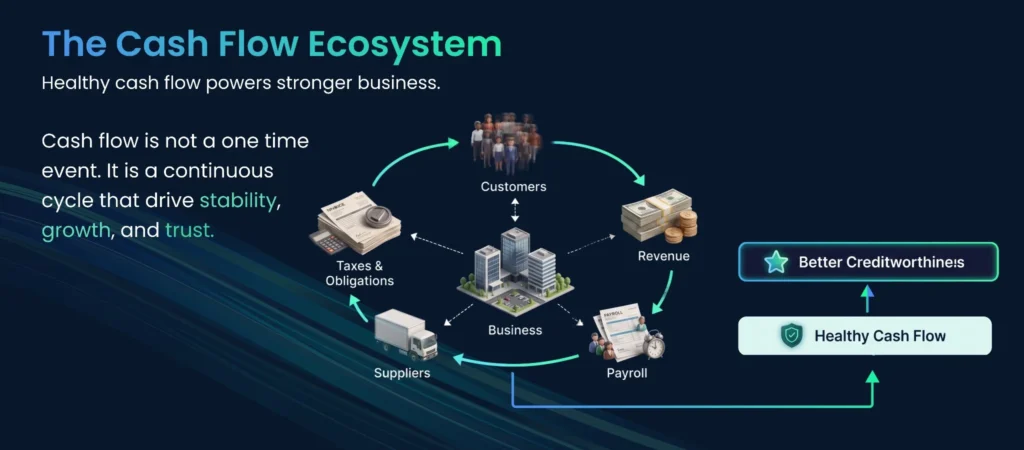
Invoices being settled on time. Revenue arriving consistently. Payroll is processed every month. Suppliers being paid without delay. These are all indicators of how a business operates in real time.
Rather than relying solely on historical financial statements, modern underwriting increasingly looks at the rhythm and consistency of cash moving through a business.
This represents a fundamental shift in how financial institutions assess risk.
Instead of asking whether a business owns enough assets to secure financing, lenders can increasingly evaluate how reliably it generates income, manages obligations, and maintains operational stability.
Cash flow becomes a dynamic measure of financial health—one that evolves with the business rather than remaining fixed in the past.
This doesn’t replace traditional credit assessment. It complements it by providing a more complete picture of how a business performs day to day.
For many SMEs, that difference can mean the difference between being declined based on limited collateral and being evaluated on the strength of their actual operations.
Unlocking Liquidity Ties Up in Receivables
When businesses experience cash flow pressure, the instinct has traditionally been to borrow. But borrowing isn’t always the problem that needs solving. In many cases, businesses aren’t waiting to generate revenue, they’re waiting to receive revenue they’ve already earned.
Consider an invoice issued to a customer with 60-day payment terms. The value already exists. The work has been completed. Yet the business must continue paying employees, suppliers, rent, and operating expenses while waiting for payment to arrive.
Working capital solutions such as invoice financing help bridge this gap by unlocking liquidity tied up in receivables. Rather than creating entirely new debt, these solutions allow businesses to access capital against income that is already expected.
The distinction is important.
The challenge isn’t always a shortage of revenue. It’s often a delay in accessing it. As financial infrastructure continues to evolve, financing is becoming less about extending credit and more about improving the speed at which businesses can access the value they have already created.
Financing Business at the Speed of Business
At Abhi, we’ve come to see working capital as more than a financing problem. It’s an infrastructure problem.
Businesses don’t operate in monthly or quarterly snapshots. They operate every day, collecting payments, paying employees, purchasing inventory, fulfilling orders, and responding to new opportunities. Yet access to capital is often still built around periodic financial statements, lengthy approval processes, and historical assessments.
We believe financial infrastructure needs to catch up with the way businesses actually operate. That means using a broader view of business performance, one that considers cash flow, transaction activity, repayment behavior, and the underlying rhythm of a company’s operations.For an SME, this can mean the difference between waiting 60 days for an invoice to be paid and accessing the liquidity needed to meet payroll, take on a new order, or keep growing today.
This is where Abhi sits: at the intersection of business cash flow and financial access, building solutions that help businesses unlock liquidity when they need it, rather than when traditional financing cycles allow it. Because the objective isn’t simply to provide more financing. It’s to make capital move at the speed of business.
Rethinking What Makes a Business Creditworthy
For decades, business finance has been built around ownership.
Collateral. Assets. Historical financial statements.
These measures will continue to matter, but they are no longer sufficient on their own. The businesses driving today’s economies increasingly create value through transactions, recurring revenue, digital operations, and continuous cash movement. Their financial health cannot always be understood through static snapshots taken months apart.
As financial systems evolve, the question is no longer simply whether a business qualifies for financing. It’s whether financing can adapt to the way modern businesses actually operate. Because in the economy being built today, cash flow is more than a financial metric. It’s becoming one of the clearest indicators of business resilience, operational health, and future growth.
If that’s the direction finance is heading, then perhaps the next generation of credit won’t be defined by what businesses own, but by how consistently they create and move value.