

Beyond Credit: Building Smarter Liquidity Solutions for Businesses in the UAE
For any business, growth is not just about generating revenue. It is also about having the liquidity to keep operations moving while that revenue makes its way into the bank account.
A business can have strong sales, a healthy pipeline and reliable customers, yet still find itself under pressure when payments arrive weeks or months after expenses are due. Payroll, suppliers, inventory and operating costs continue on schedule, while receivables may not.
This gap between money earned and money available can become a significant constraint on business growth.
And for small and medium-sized enterprises (SMEs), the challenge is even more pronounced.
The liquidity gap behind business growth
SMEs are the backbone of economies around the world. According to the World Bank, small and medium-sized enterprises account for around 90% of businesses globally and contribute more than 50% of employment. Yet despite their economic importance, many continue to face difficulties accessing appropriate and timely financing.
The International Finance Corporation (IFC) estimates that 40% of formal micro, small and medium-sized enterprises (MSMEs) in developing countries face an annual financing gap, with the total gap estimated at approximately $5.2 trillion.
The challenge is also particularly relevant across the Middle East, North Africa, Afghanistan and Pakistan (MENAP) region. Approximately 32% of firms in MENAP identify access to credit as a major business constraint, compared with a global average of 26%, according to the IMF.
For many businesses, the issue is not necessarily a lack of commercial activity or future revenue. Instead, it can come down to the difficulty of accessing capital at the point when it is needed.
When traditional financing doesn’t fit the business
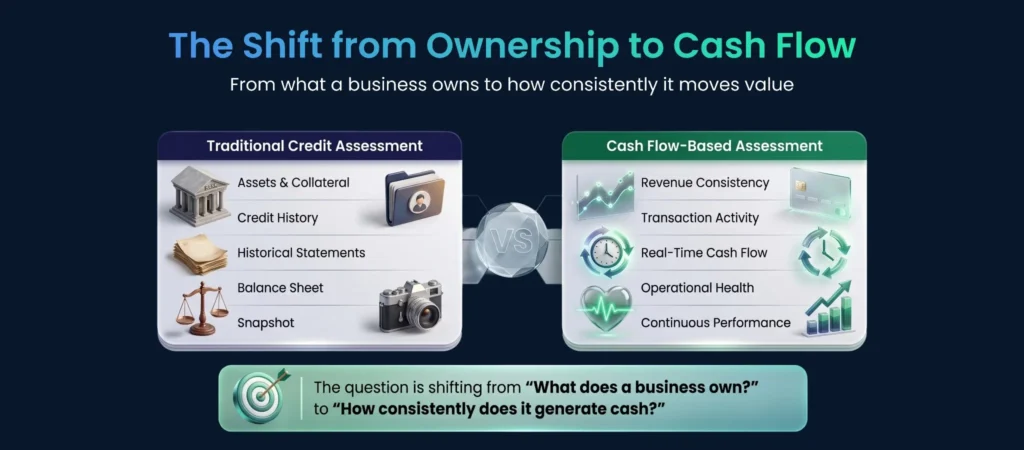
Traditional lending can work well for businesses with established credit histories, significant fixed assets, and predictable credit requirements. But not every business fits that profile.
A growing B2B company may have substantial approved invoices but need to wait 60 or 90 days to receive payment. An expanding business may have immediate expenses related to inventory or operations but limited short-term liquidity. A digital merchant may generate consistent transaction volumes but have limited access to conventional forms of collateral-based credit.
These businesses can have strong underlying economic activity while still experiencing a temporary liquidity constraint.
Collateral requirements, information gaps, transaction costs, and limited availability of financing products tailored to SME needs can further restrict access to finance.
This creates a fundamental mismatch:
The value exists, but the liquidity is tied up.
The cash-flow challenge in practice
Consider a business that has completed a project for a large corporate customer.
The work is complete. The invoice has been approved. The revenue has effectively been earned.
But the payment terms are 60 or 90 days.
The business, meanwhile, still needs to pay employees, suppliers, and other operating expenses today. It may also have another opportunity that requires upfront investment.
Waiting for the invoice to be paid could mean slowing down operations or passing up an opportunity.
This is why business liquidity is increasingly about more than simply accessing credit. It is about bridging timing gaps and making existing business value more accessible.
Four solutions for different business needs
1. Invoice Factoring: Unlocking cash tied up in receivables
For businesses that operate on credit terms, outstanding invoices can represent significant value.
The challenge is that an invoice does not become cash until the customer pays.
Abhi’s Invoice Factoring enables businesses to access credit against approved invoices, helping unlock liquidity that would otherwise remain tied up in receivables.
Rather than waiting through a 30-, 60- or 90-day payment cycle, eligible businesses can use the value of their approved invoices to support their immediate cash-flow requirements.
This can be particularly valuable for B2B businesses working with established buyers where extended payment terms are part of the commercial relationship.
2. Working Capital Financing: Keeping everyday operations moving
Liquidity requirements extend beyond outstanding invoices.
Businesses need to manage inventory, supplier payments, operating expenses, and other day-to-day costs. They may also need short-term capital to support expansion, fulfil a new order or take advantage of an emerging opportunity.
Abhi’s Working Capital Financing provides short-term liquidity to help businesses manage these requirements.
The objective is to give businesses greater flexibility in managing the timing between cash going out and cash coming in, without allowing temporary liquidity constraints to interrupt ongoing operations.
3. Platform-Based Lending: Liquidity built around business activity
As more businesses operate through digital platforms, these platforms increasingly capture valuable information about business activity and performance.
Abhi’s Platform-Based Lending enables embedded financing through platform transaction data and performance.
By bringing credit closer to the platforms where businesses already operate, businesses can potentially access liquidity within the context of their existing commercial activity rather than navigating an entirely separate credit journey.
This creates a more connected approach to liquidity, one where access to liquidity can be linked to actual business activity and performance.
4. Payroll Relief: Bridging the gap when salaries are due
Payroll is one of the most critical financial commitments a business has.
Yet even businesses with healthy operations can experience temporary timing mismatches between incoming revenue and payroll obligations.
Abhi’s Payroll Relief provides bridge financing to help businesses pay employee salaries on time when cash-flow timing creates a temporary gap.
For employers, this provides greater flexibility in managing short-term liquidity. For employees, it helps maintain the reliability of one of the most important financial commitments they depend on.
One liquidity challenge, different financing needs
There is no single reason why a business may need credit, and there should not be a single solution for every business.
A B2B company waiting on a large invoice has a different need from a business purchasing inventory. A digital merchant may benefit from financing embedded within the platform where it conducts its business, while another company may simply need short-term liquidity to ensure payroll is processed on time.
The underlying challenge, however, is often the same:
Cash does not always arrive when the business needs to spend it.
This is why the next evolution of business financing is not simply about making more credit available. It is about making financing more timely, relevant, and aligned with the way businesses actually operate.